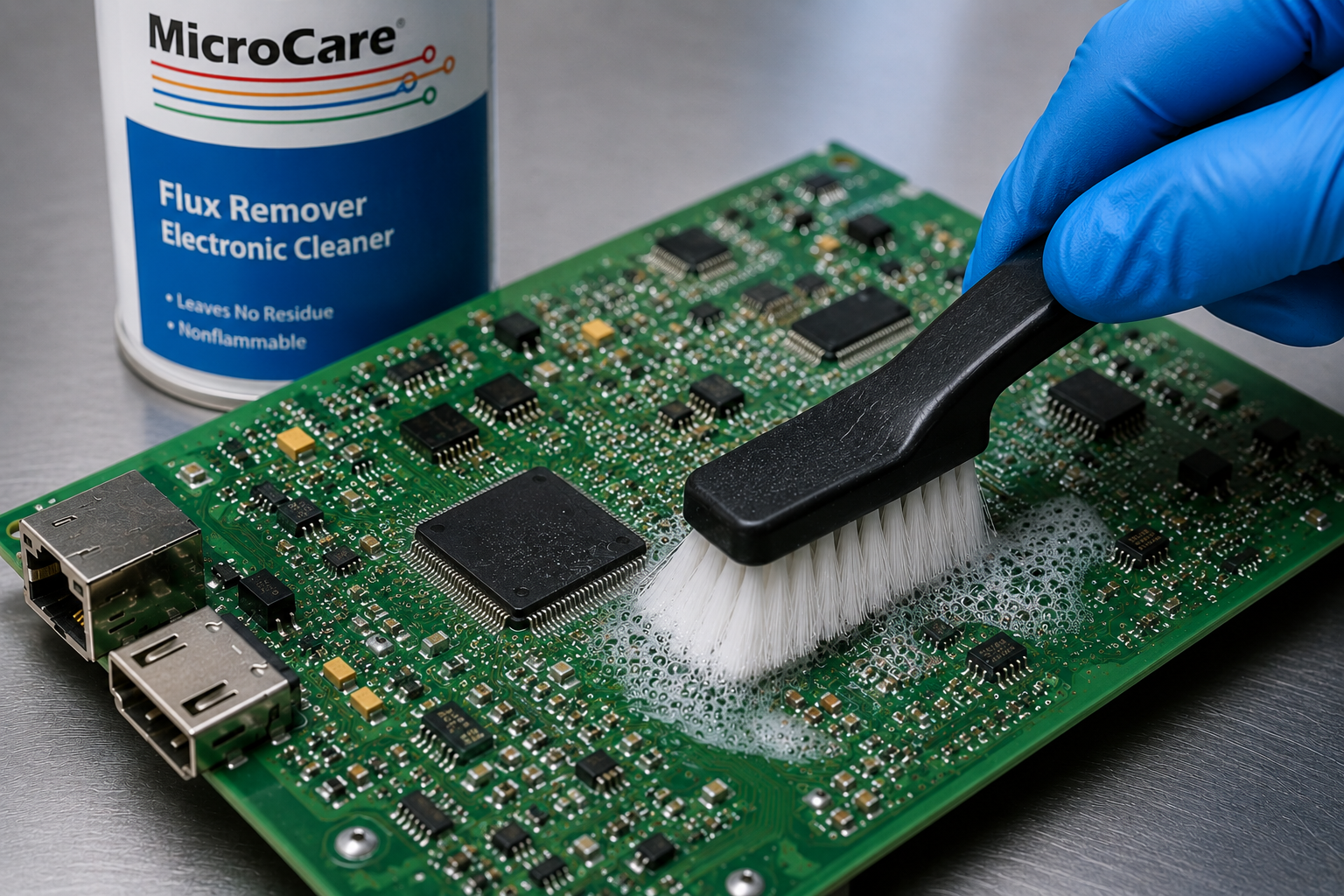
MicroCare Flux Removal in Electronic Assembly Cleaning
Introduction
In modern electronics manufacturing, flux plays a critical role in ensuring reliable solder joints by removing oxides and improving wettability. However, after soldering, flux residues can remain on printed circuit boards (PCBs), creating potential risks to performance and long-term reliability. MicroCare specializes in advanced cleaning technologies designed to effectively remove these residues and ensure high-quality electronic assemblies.
Why Flux Removal is Essential
Historically, “no-clean” fluxes were developed to eliminate the cleaning step. However, as PCB designs become more complex and densely populated, leaving residues is no longer always acceptable.
Key reasons for flux removal include:
1. Reliability and Performance
Flux residues—especially from no-clean formulations—can lead to electrical leakage, electrochemical migration, and dendritic growth. These issues can cause circuit instability or failure over time.
2. Signal Integrity
Residues can interfere with signal transmission, particularly in high-frequency or high-voltage applications, introducing noise and reducing performance.
3. Corrosion Risk
Activators within flux can leave ionic residues that attract moisture, leading to corrosion of delicate PCB components.
4. Conformal Coating Adhesion
Residual contamination can prevent proper adhesion of conformal coatings, causing delamination and exposing circuits to harsh environments.
5. Inspection and Aesthetics
Clean boards improve visual inspection accuracy and meet customer expectations for quality appearance.
Types of Flux and Cleaning Challenges
Different flux chemistries require tailored cleaning approaches:
- No-clean flux: Leaves minimal residue but can be difficult to remove once baked-on
- Rosin (R, RMA, RA): Requires solvent-based cleaning
- Water-soluble (OA): Highly active and must be thoroughly cleaned to prevent corrosion
With miniaturized components such as BGAs, QFNs, and CSPs, residues can become trapped under low standoff parts, making cleaning even more challenging.
MicroCare Flux Removal Solutions
MicroCare provides a range of precision cleaning fluids engineered for different flux types and applications. Key features include:
- High solvency power for removing tough no-clean residues
- Low surface tension to penetrate under tight components
- Fast drying or controlled evaporation options
- Compatibility with plastics and sensitive materials
- Nonflammable and low-VOC formulations for safety and compliance
Examples of MicroCare solutions include:
- Alcohol-enhanced cleaners for general flux removal
- Nonflammable defluxers for safe industrial use
- Precision aerosol cleaners for targeted applications
These cleaners are suitable for SMT, through-hole assemblies, connectors, and cables.
Best Practices for Flux Removal
To achieve optimal cleaning performance, MicroCare recommends:
1. Match Cleaner to Flux Type
Selecting the correct chemistry ensures effective residue removal without damaging components.
2. Follow a Structured Cleaning Process
A typical manual cleaning method includes:
- Wet → Scrub → Rinse → Dry
3. Control Soldering Conditions
Proper reflow temperature prevents flux from baking onto the PCB, making cleaning easier.
4. Validate Cleaning Early
Testing cleaning processes during product development helps avoid production issues and ensures reliability.
5. Ensure Material Compatibility
Cleaning fluids must be safe for substrates, coatings, and sensitive components.
Industry Trends Driving Flux Cleaning
Despite the rise of no-clean fluxes, industry trends are pushing manufacturers back toward cleaning:
- Increasing PCB density and miniaturization
- Higher reliability requirements (automotive, aerospace, medical)
- Growth of conformal coating applications
- Stricter quality and inspection standards
As a result, many manufacturers now clean all assemblies—not just high-reliability products—to prevent costly failures and returns.
Conclusion
Flux removal is no longer an optional step in many electronic assembly processes. With increasing circuit complexity and reliability demands, proper cleaning is essential to ensure product performance, durability, and quality.
MicroCare’s advanced flux removal solutions provide manufacturers with effective, safe, and reliable cleaning options tailored to modern electronics. By combining the right chemistry with optimized processes, companies can significantly reduce defects, improve yield, and enhance long-term product reliability.
Please contact GlueRu to provide solutions to your challenges!