Why DOWFROST™ LC25 Is Better Than Diluted DOWFROST™ HTF for Data Center Cooling
Introduction
As modern data centers transition from air cooling toward direct-to-chip liquid cooling and high-density rack cooling, selecting the correct heat transfer fluid becomes critical. While both DOWFROST™ LC25 and DOWFROST™ HTF are based on propylene glycol technology, they are engineered for different applications.
Many operators assume diluted HTF can replace LC25. However, this approach introduces risks in corrosion protection, fluid stability, and long-term system reliability—especially in mission-critical environments such as data centers.
This article explains the differences and demonstrates why LC25 is the superior choice.
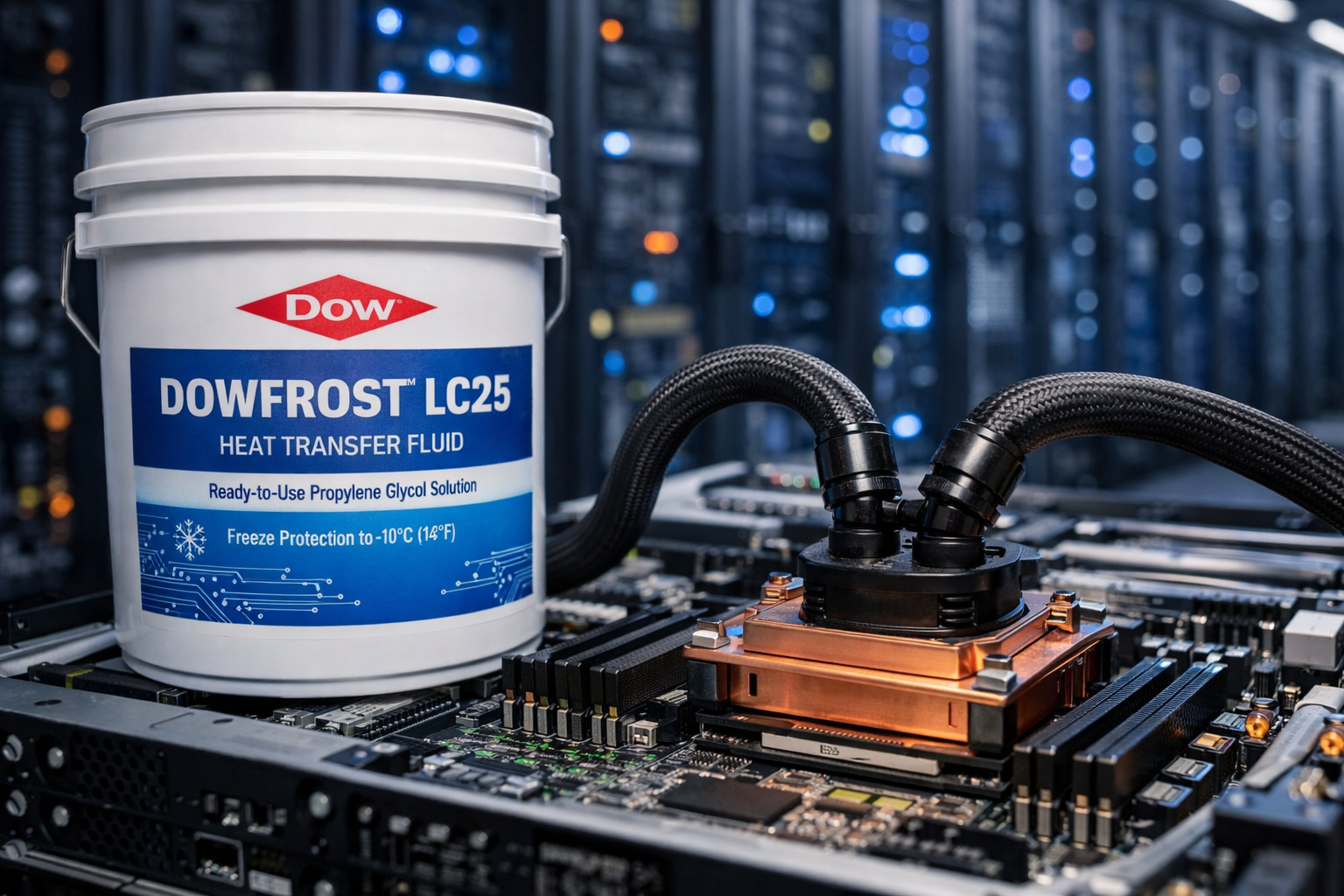
DOWFROST™ LC25
DOWFROST™ LC25 is a ready-to-use inhibited propylene glycol solution (≈25%) specifically designed for:
- Direct-to-chip cooling
- Datacom equipment cooling loops (DECS)
- Closed-loop electronics cooling
- High-surface-area copper systems
It includes a specialized inhibitor package optimized for electronics cooling environments and provides freeze protection down to −10 °C.
DOWFROST™ HTF (Diluted with DI Water)
DOWFROST™ HTF is a propylene glycol concentrate (~96%) intended primarily for:
- HVAC systems
- food/pharmaceutical processing
- geothermal loops
- industrial heating/cooling
Users must dilute HTF with DI water to achieve the required concentration before use.
This flexibility is useful in HVAC applications—but not ideal for precision electronics cooling systems.
Key Differences Between LC25 and Diluted HTF
| Parameter | DOWFROST™ LC25 | Diluted DOWFROST™ HTF |
|---|---|---|
| Delivery format | Ready-to-use | Requires field dilution |
| Target application | Data center cooling | HVAC / industrial loops |
| Inhibitor optimization | Electronics-grade | General purpose |
| Copper protection | High | Moderate |
| Risk of mixing error | None | High |
| Water quality dependency | None | Critical |
| Maintenance interval | Long | Shorter |
| Reliability consistency | Factory controlled | Operator dependent |
Why Diluted HTF Creates Risk in Data Centers
1. Inhibitor Concentration May Be Incorrect
LC25 is factory-formulated with the correct inhibitor chemistry for electronics cooling systems.
Diluting HTF in the field changes:
- inhibitor concentration
- pH stability
- corrosion protection performance
Incorrect dilution increases the risk of:
- copper corrosion
- aluminum attack
- scaling
- microbiological growth
Dow explicitly states LC25 is ready-to-use and should not be diluted because dilution reduces corrosion-protection effectiveness.
2. Water Quality Strongly Affects System Reliability
When HTF is diluted locally, performance depends heavily on water purity.
Contaminants such as:
- chloride
- sulfate
- hardness ions
- iron
can dramatically reduce coolant lifetime and increase corrosion risk.
By contrast:
LC25 already contains controlled, high-purity water and inhibitor balance from factory production.
3. Data Centers Require Copper-Compatible Inhibitor Systems
Modern liquid cooling loops include:
- copper cold plates
- brazed heat exchangers
- brass fittings
- aluminum manifolds
LC25 includes a special inhibitor package designed specifically for high-surface-area copper components used in direct-to-chip cooling.
Diluted HTF does not provide the same optimized protection level.
4. LC25 Provides Stable Long-Term Cooling Performance
LC25 uses USP-grade propylene glycol (>99.8% purity) with tightly controlled chemistry that reduces:
- oxidation
- fouling
- odor formation
- foaming
- degradation
This improves:
- system uptime
- maintenance intervals
- coolant lifetime
especially important for hyperscale and AI-driven facilities.
5. LC25 Supports Direct-to-Chip Cooling Architectures
Direct-to-chip cooling systems now support:
- 50–100 kW rack density
- GPU clusters
- AI compute infrastructure
LC25 is engineered specifically for these Technology Cooling Systems (TCS) and delivers efficient heat removal with corrosion protection and leak detection capability.
Diluted HTF was not originally designed for this environment.
6. LC25 Reduces Operational Risk in Mission-Critical Facilities
Data centers prioritize:
- uptime
- predictability
- warranty compliance
- serviceability
LC25 improves reliability because it is:
- pre-mixed
- quality-controlled
- inhibitor-balanced
- biostable
- dyed for leak detection
and tested specifically for closed-loop electronics cooling applications.
Total Cost of Ownership Comparison
Although diluted HTF may appear cheaper initially, hidden risks increase lifecycle cost:
| Cost Factor | LC25 | Diluted HTF |
|---|---|---|
| Mixing labor | None | Required |
| Water treatment | None | Required |
| Quality variation risk | None | High |
| Corrosion failure risk | Low | Medium–High |
| Maintenance frequency | Low | Higher |
| System downtime risk | Low | Higher |
For mission-critical infrastructure like data centers, fluid reliability is more valuable than small upfront savings.
Conclusion
Both DOWFROST™ LC25 and DOWFROST™ HTF are high-quality propylene glycol heat transfer fluids. However, they are designed for different purposes.
DOWFROST™ LC25 is the preferred solution for data center cooling because it:
- is factory-prepared and ready to use
- contains inhibitors optimized for copper-rich electronics cooling loops
- eliminates dilution variability risks
- improves long-term corrosion protection
- supports direct-to-chip cooling architectures
- reduces maintenance and operational risk
For modern high-density compute environments, LC25 provides higher reliability, better protection, and lower lifecycle risk than diluted HTF solutions.
Please contact GlueRu to provide solutions to your challenges!