Beyond Thermal Grease: Why Phase Change Materials (PCMs) Are the Future of High-Reliability Electronics Thermal Design
In the electronics manufacturing industry, the push for smaller form factors, higher processing speeds, and dense power configurations has pushed traditional thermal management to its absolute limits. For decades, thermal grease (thermal paste) has been the go-to Thermal Interface Material (TIM). It is cheap, universally available, and delivers low thermal resistance during initial lab testing.
However, as devices scale into modern high-power territory—such as electric vehicle (EV) controllers, AI edge computing, 5G telecom modules, and automotive radar—thermal grease is increasingly exposing its greatest vulnerability: long-term degradation.
For engineers seeking a zero-maintenance, high-yield alternative, Phase Change Materials (PCMs) are stepping up as the definitive solution to replace messy pastes.
The Fatal Flaw of Thermal Grease: The “Pump-Out” Effect
While high-quality thermal grease can achieve an incredibly thin bond-line thickness (BLT), its physical state remains a viscous fluid throughout its operating life. As high-power microprocessors cycles through heavy processing loads, they experience extreme, rapid temperature swings. This cyclic heating and cooling causes micro-expansion and contraction of the silicon die and the heatsink.
This mechanical expansion acts like a slow pump, gradually squeezing the thermal grease outward from the center of the chip over time—a phenomenon known as the “pump-out effect.” Within 1 to 2 years of field operation, dry zones form in the critical center of the die, causing localized hotspots, thermal throttling, or outright component failure. Furthermore, the silicone or synthetic oils used in grease eventually evaporate or separate, leaving behind a dry, crusty matrix that completely loses its thermal conductivity.
Enter PCMs: The Solid-to-Liquid Advantage
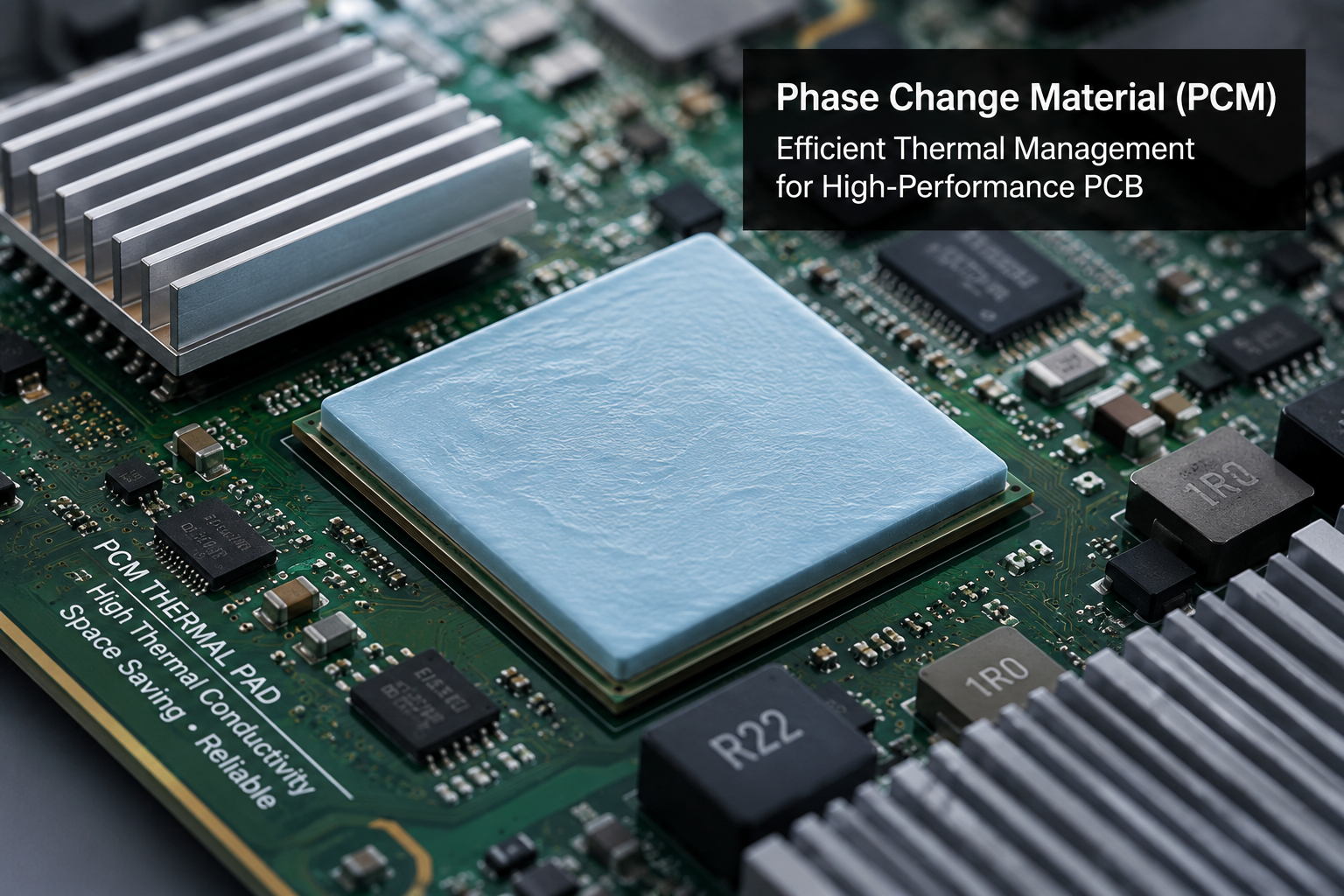
Phase Change Materials (PCMs) solve the long-term reliability issues of thermal paste by changing their physical properties exactly when it matters. At room temperature, a PCM TIM is a solid, stable pad or pre-dispensed film.
Once the electronics power on and the chip reaches its activation/melting temperature (typically between 45°C and 60°C), the PCM transitions into a highly conformable, liquid-like state. Under the mechanical clamping pressure of the heatsink, it softens completely, filling the microscopic air gaps and surface imperfections of the substrate just like thermal grease.
However, PCMs offer distinct advantages that paste cannot match:
- Immunity to Pump-Out: Because the material is bound by high surface tension when melted and solidifies back into a stable matrix when cooled, it physically cannot pump out or migrate away from the die.
- Zero Evaporation or Drying: PCMs do not rely on volatile carriers or liquids that evaporate over time. Their structural and thermal properties remain stable over thousands of rapid thermal cycles, providing a reliable lifespan that matches or exceeds the application itself (often 10+ years).
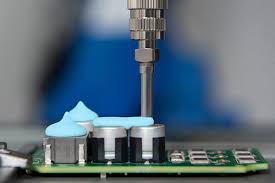
- Optimized Factory Throughput: Dispensing thermal grease uniformly on an automated assembly line is notoriously messy, introduces human error, requires regular valve cleaning, and runs the risk of paste overflowing onto critical surrounding PCB components. PCM can be delivered as pre-cut, stamped pads easily picked and placed by automated machinery, eliminating clean-up time and maximizing manufacturing yield.
Key Industries Migrating to PCM Technology
While consumer tech manufacturers have already widely adopted premium PCM compounds (like Honeywell PTM7950) to protect laptops and gaming consoles from losing performance over time, industrial-grade PCMs are seeing explosive growth in key sectors:
- Automotive & EV Systems: Advanced Driver Assistance Systems (ADAS), battery modules, and on-board chargers operate under severe vibrational and thermal cycles where field failures lead to expensive automotive recalls. PCMs provide the exact rugged longevity required here.
- 5G Telecommunications: Outdoor remote radio units and base stations are sealed systems exposed to extreme weather variations. Sending a field technician to clean and re-paste dried thermal grease on a cell tower is financially prohibitive; PCM ensures decades of hands-off cooling performance.
- Industrial Automation: High-power motor drives and factory control modules placed in harsh environments demand sealed, resilient thermal boundaries that never degrade.
Evaluating Total Cost of Ownership (TCO)
When evaluating materials solely on a raw material cost per gram basis, thermal grease often looks like the cheaper option. However, forward-thinking R&D and procurement teams look at the Total Cost of Ownership (TCO). When you factor in the automated assembly speed, zero factory rework from messy spills, and the complete elimination of warranty claims due to dry or pumped-out paste, PCMs prove to be the more cost-effective, high-yield choice for high-reliability applications.
Stop designing around the limitations of expiring thermal grease. Give your engineering cycle more freedom, shorten your development time, and protect your electronics in the harshest environments.
Looking to transition your high-power electronics from thermal grease to advanced Phase Change Materials? GlueRu can assist you from design validation to production with same performance as global material options tailored to your specific application.
Please contact GlueRu to provide solutions to your challenges!