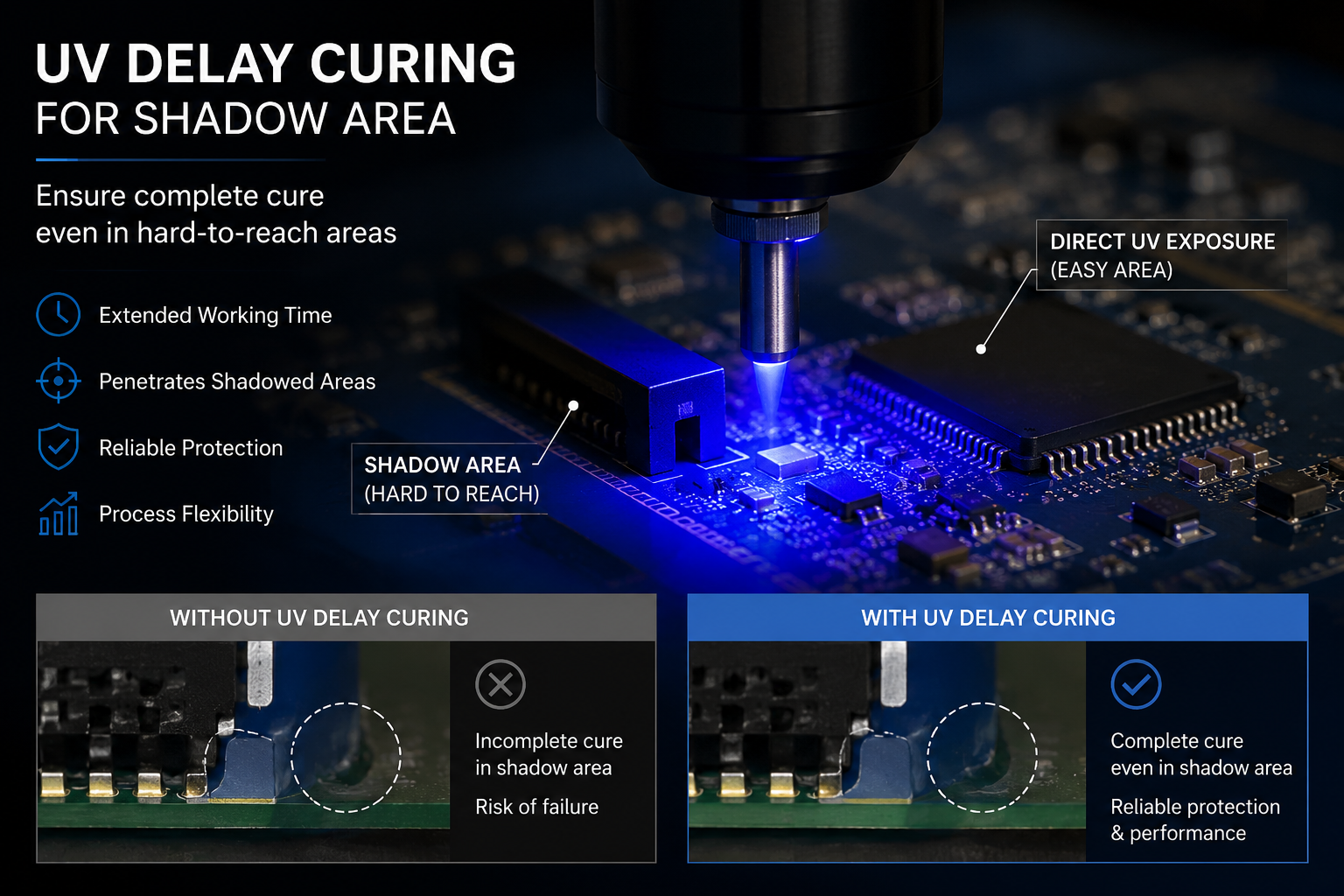
Understanding Delay UV Cure Epoxy: The Perfect Solution for Opaque Substrates
In high-precision assembly, medical device manufacturing, and electronics packaging, traditional UV-curable adhesives often face a major hurdle: the line-of-sight limitation. Standard UV adhesives require constant, direct light exposure to polymerize completely. This becomes an impossible requirement when bonding opaque substrates, joining hidden components, or working with complex 3D architectures.
To solve this challenge, engineers are increasingly turning to Delay UV Cure Epoxy (frequently referred to as “dark cure” epoxy). Unlike conventional systems, these specialized cationic epoxies can be pre-activated with light and will continue to cure flawlessly even after the light source is removed.
The Problem with Traditional Free Radical Adhesives
Most standard UV and LED-curable adhesives (typically acrylated urethane polymers) rely on free radical polymerization. This process is prized for its extreme speed, often curing in under 10 seconds under intense light.
The mechanism follows a strict chain reaction:
- UV or LED light hits the adhesive, activating built-in photoinitiators.
- These photoinitiators instantly transform into highly reactive radical species.
- The free radicals rapidly attack nearby monomers, turning them into radicals that bind with other monomers.
While highly efficient, free radical propagation stops almost the exact millisecond the light source is blocked or turned off. Because they require 100% direct light exposure throughout the entire polymerization process, they are entirely unsuited for bonding through opaque or light-blocking materials.
The Chemistry Behind Cationic Epoxies
Delay UV cure systems bypass this limitation by utilizing cationic chemistry. Instead of generating fleeting free radicals, the photoinitiators in a cationic epoxy react to UV or LED light by generating a stable Lewis or Brønsted acid.
This acid acts as the catalyst:
- The acid reacts with monomers to create positively charged cations.
- These cations continuously attack adjacent monomers to propagate the polymer chain.
- Because the chemical mechanism is inherently more stable, the curing process continues steadily even in total darkness.
What Creates the “Delay” or “Open Time”?
The defining feature of a delay UV cure epoxy is its open time. While free radicals react with monomers in a fraction of a second, the acids generated in cationic systems can exist within the liquid mixture for a significantly longer duration before being fully quenched.
This behavior allows for a highly controlled assembly process:
- Pre-Activation: The liquid epoxy is exposed to a brief burst of UV/LED light while still uncovered. This initiates the acid generation.
- Open Time Window: Depending on the formulation, the adhesive remains a workable liquid for a temporary window (typically anywhere from 30 seconds to 2–3 minutes).
- Mating Substrates: Technicians or automated dispensing systems utilize this open time to mate the opaque substrates together.
- Shadow Curing: Once the parts are joined and the light is completely blocked, the chemical reaction continues in the dark. The adhesive achieves full structural cure over the next 24 hours (or can be heat-accelerated if a faster cycle time is needed).
Why Choose Delay UV Cure Epoxy?
Integrating delay-cure cationic epoxies into your production line offers distinct manufacturing advantages:
- Bond Opaque Materials: Securely join plastics, metals, ceramics, and other materials where light cannot penetrate.
- Flexible Assembly Windows: Open times provide predictable processing buffers for precise alignment before final mating.
- Reliable Shadow Curing: Eliminates the risk of uncured liquid pockets inside complex geometries, ensuring consistent mechanical strength and environmental sealing.
- Excellent Physical Properties: Cationic epoxies typically deliver superior chemical resistance, thermal stability, and low shrinkage compared to free radical acrylics.
For advanced electronics, optical packaging, hard disk drive, and medical assemblies where precision dispensing and reliable bonding are mandatory, delay UV cure epoxies offer a reliable path past the limitations of traditional light curing.
Please contact GlueRu to provide solutions to your challenges!