Low RI Materials: Enabling the Next Gen of Photonics & Optoelectronics
As photonics and optoelectronics continue evolving toward higher speed, smaller size, and lower optical loss, material engineering has become one of the most critical technologies in modern optical systems. Among these advanced materials, Low Refractive Index (Low RI) resins and adhesives are increasingly important for optical packaging, fiber optics, AR/VR displays, photonic integrated circuits (PIC), and nano-optics.
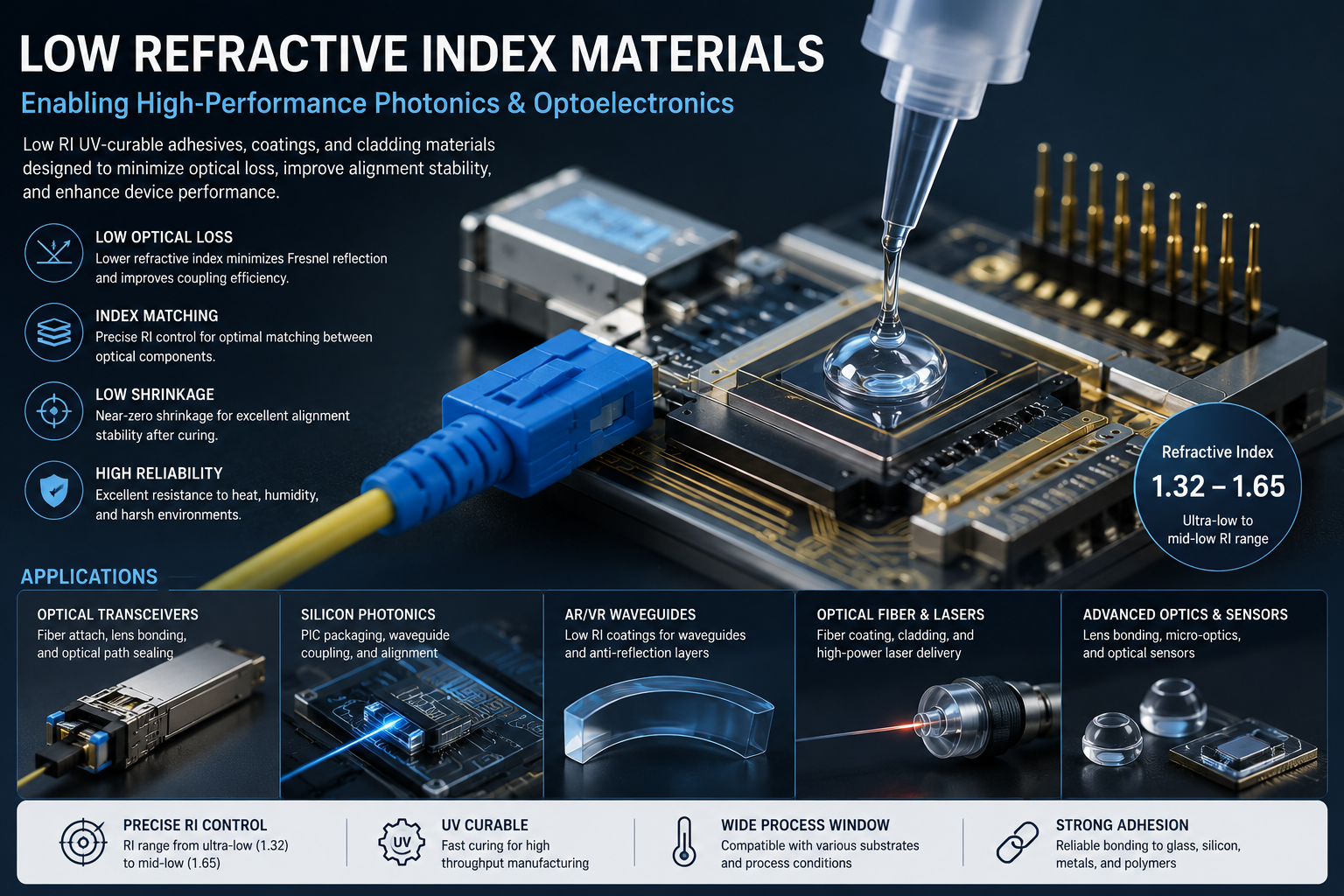
GlueRu is one of the specialized companies focusing on ultra-low refractive index UV-curable materials for high-end photonic applications. The company offers materials with refractive index values ranging from approximately 1.32 to 1.65, targeting optical industries where precise light control is essential.
Why Refractive Index Matters in Photonics
The refractive index (RI) determines how light propagates through a material. In optical systems, mismatched RI between components can cause:
- Fresnel reflection
- Optical insertion loss
- Beam distortion
- Alignment instability
- Reduced coupling efficiency
Low RI materials are therefore essential in applications where efficient light guiding, optical isolation, or precise index matching is required.
In advanced photonics packaging, even a small RI mismatch can significantly affect signal integrity, especially in:
- 400G/800G optical transceivers
- Silicon photonics
- Fiber laser systems
- Optical sensors
- AR/VR waveguides
Key Advantages of Low RI Materials
1. Reduced Optical Loss
Low RI adhesives minimize reflection at optical interfaces and improve coupling efficiency between fibers, lenses, and waveguides.
The OA series optical adhesives are designed specifically for optical path joining and device fixing with refractive index values as low as 1.375–1.400.
2. Improved Alignment Stability
Conventional UV adhesives often shrink during curing, causing optical misalignment. This becomes critical in photonics packaging where micron-level alignment is required.
Our engineers developed optical epoxy systems with “0% curing shrinkage,” enabling stable optical alignment after curing. Their OA-4861 and OA-1583EP series are designed specifically for precision optical assembly.
3. Better Reliability in Harsh Environments
Photonics devices increasingly operate under:
- High temperature
- High humidity
- High optical power
Our materials are engineered for harsh environments, with several products passing long-term 85°C/85% RH reliability testing and high-temperature operation up to 200°C.
Major Applications in Photonics & Optoelectronics
Fiber Lasers & Optical Fiber
Low RI polymer cladding materials are widely used in:
- Double-clad fiber (DCF)
- Hard-clad fiber (HCF)
- Fiber recoating
- High-power laser delivery
Our PC Series materials provide RI values down to 1.320 with excellent adhesion and optical transmittance for fiber laser industries.
These materials are particularly important for industrial lasers, medical lasers, and telecom fiber systems.
Optical Packaging & Silicon Photonics
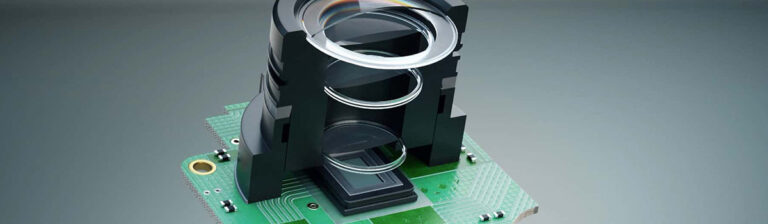
Photonic integrated circuits (PICs) require ultra-precise optical coupling and stable beam alignment.
Low RI adhesives are used for:
- Beam path fixing
- AWG assembly
- Splitter packaging
- Fiber attach
- Lid glass bonding
The OA-9352 and OA-1583EP series target these applications with low shrinkage and excellent index matching properties.
As AI data centers accelerate demand for 800G and co-packaged optics, optical packaging materials are becoming increasingly strategic.
AR/VR & Advanced Display
In AR/VR systems, controlling light propagation inside waveguides is essential for image quality and efficiency.
The SFH series low RI coatings are designed for:
- Waveguides
- Anti-reflection layers
- OLED optics
- Flexible displays
- Light guide films
The company offers UV-curable low RI materials with RI values as low as 1.330 for advanced display applications.
Nano-Optics & 3D Printed Photonics
Emerging technologies such as nano-imprint lithography and nano 3D printing require materials with highly controlled optical properties.
We developed:
- PC-NI Series for nano-imprinting
- PC-ND Series for nano 3D printing
- PC-OG Series for inkjet-printed optics
These materials support rapid prototyping and fabrication of micro-optical structures with controlled RI from 1.320 to 1.670.
Future Trends: Photonics Needs Better Materials
Modern photonics increasingly demands:
- Lower optical loss
- Smaller packaging
- Higher power density
- Better thermal stability
- Faster manufacturing
Research in integrated photonics also continues pushing optical material engineering to enable low-loss and high-index-contrast devices for visible and UV photonics.
As optical systems become more complex, advanced functional materials will become just as important as semiconductor devices themselves.
Conclusion
Low refractive index materials are no longer niche specialty chemicals; they are becoming enabling technologies for the next generation of photonics and optoelectronics.
From fiber lasers and optical transceivers to AR/VR and nano-photonics, low RI UV-curable resins and adhesives help improve:
- Optical efficiency
- Alignment precision
- Reliability
- Manufacturing scalability
With more than 30 years of expertise in low RI chemistry, our engineers have developed a broad portfolio of materials supporting advanced photonics industries worldwide.
Please contact GlueRu to provide solutions to your challenges!